The opening ceremony of the 2026 Guizhou Provincial Week of Lifelong Learning was held on August 7 in Kaili, advancing the implementation of the “Outline for Building a Strong Education Country (2024–2035)” by promoting an accessible, ubiquitous lifelong education system. Organized by the Provincial Department of Education, the Qian Dongnan Prefecture Government, and Guizhou Open University, with co-organization from the Prefectural Education Bureau, Kaili Municipal Government, and Qian Dongnan Open University, the event centered on the theme “Let Learning Become a Lifestyle,” embodying the vision that “Learning for all, learning anywhere, learning anytime.”
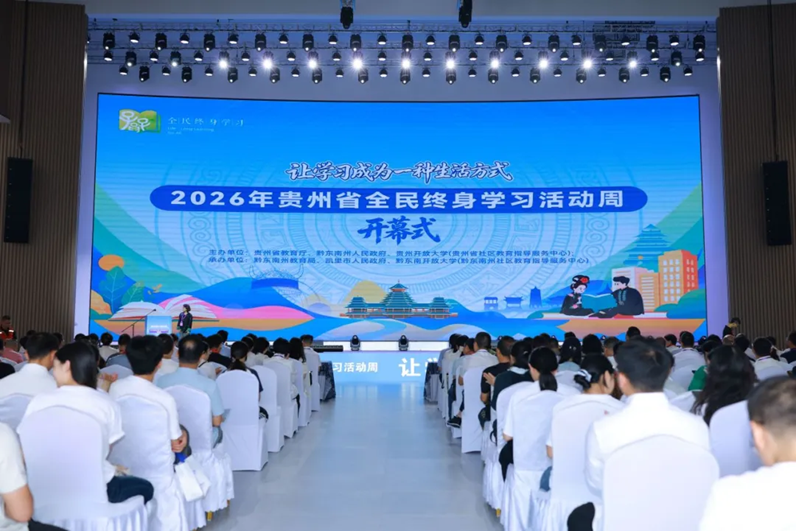
The event featured exhibition zones showcasing community education achievements, calligraphy and photography, as well as intangible cultural heritage such as Miao and Dong embroidery, tie-dye, and bamboo weaving. Heritage practitioners participated interactively, helping transform folk traditions into educational content. Vice Governor Yang Chengjin delivered a speech highlighting how local initiatives like “Village Basketball” (“Cun BA”), “Village Super League” (“Cun Chao”), and “Village Fashion Show” (“Cun T”) have turned intangible heritage into inclusive platforms, building a comprehensive community education network across the region. He also announced the list of awardees for the “People’s Learning Stars” and “Lifelong Learning Brand Projects,” followed by award presentations and plaque ceremonies. Linghu Caitao, Party Secretary of Guizhou Open University, reported on the achievements of the five-tier educational network. Zhang Minghua, Deputy Director of the Provincial Department of Education, officially declared the event open and outlined strategic priorities including implementing national policies, addressing gaps, and fostering a supportive learning environment. Performances included the traditional drum dance “Yelang Battle Drum” and the choral rendition of “My Motherland and Me,” integrating intangible heritage, folk culture, elderly wellness, and youth aesthetic education.
Following the ceremony, delegations visited Future City Community—known for its “Red Stewardship” model—and Xiasi Town, which exemplifies the integration of culture-tourism, study tours, and community education. These visits helped identify two successful models: urban inclusivity and cultural-tourism synergy. Moving forward, efforts will focus on strengthening the five-tier network, scaling up exemplary programs, deepening the use of red cultural resources, enriching educational reading and senior care services, and enhancing integrated learning channels through the “Guizhou Lifelong Learning Online” platform. The goal is to build a ubiquitous, diverse, and inclusive lifelong education system where learning becomes a new social norm.
Editor: School of International Studies Wang Xin
Translator: Public Basic Course Department Sun Tingting
Chief Editor: School of International Studies Zhang Wen
Senior Editor: School of International Studies Chen Lina


